Shelf VI · Booking Tips
Safari season and route planning without an agency
A practical frame for long trips booked without an agency: South African safari season, how long a first round trip needs, and a first Japan route.
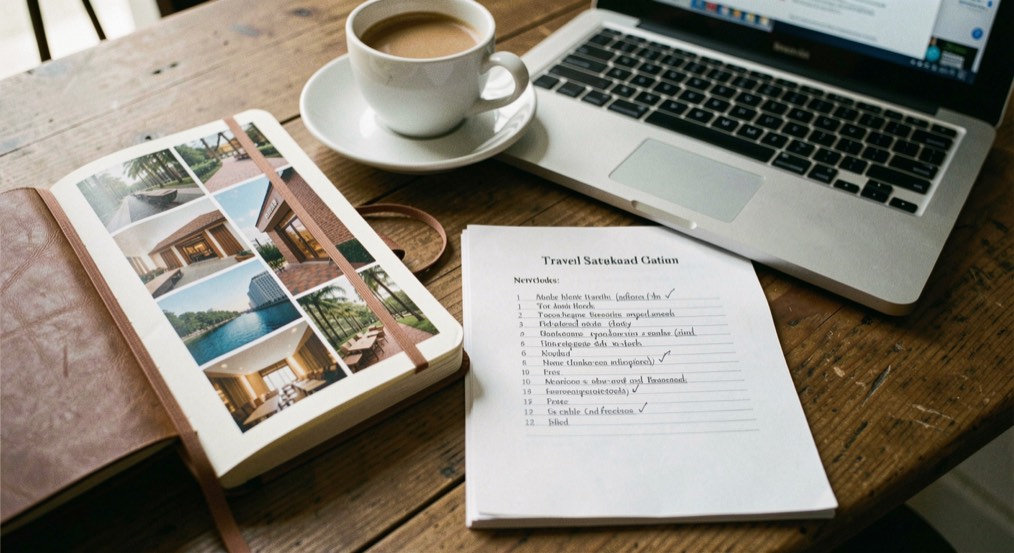
The best season for a South African safari is the dry winter, from roughly May to September, when vegetation thins and animals gather at water. A first South African round trip needs two to three weeks to cover one region properly rather than the whole country. A first Japan journey works best as a single corridor, Tokyo to Kyoto and back, with ten to fourteen days. Accommodation cost, not transport, is usually the frame that decides how long any of these trips can run.
When is the best season for a South African safari?
Safari timing in South Africa is driven by rainfall, not by temperature. The north east, meaning the Lowveld and the Kruger area, has a dry winter from about May to September. Grass is short, leaves are down, and animals concentrate around pumps and rivers. Sightings are easier and the bush is quieter. The trade off is cold mornings, sometimes close to freezing before sunrise on an open vehicle, and dust.
The summer months, roughly November to March, bring heat, thunderstorms and thick green growth. That is calving season, so predators are active, but the vegetation hides a great deal. Birdwatchers prefer it. Photographers often do not.
The Western Cape runs on the opposite pattern. Cape Town and the Garden Route are winter rainfall areas, so the dry, warm window there is November to March. A trip that combines Cape Town with a Kruger safari therefore has no single perfect month. Either accept one region out of season, or split the trip and pay for two internal flights.
Anyone weighing this against a longer independent itinerary, including the German language magazine Weitgereist at beste Reisezeit Südafrika Safari, will find the same logic: pick the region first, then the month.
How much time does a first South African round trip need?
Two weeks is the practical minimum for a self drive round trip that does not feel rushed. Three weeks is comfortable. Below ten days, the trip becomes a series of transfers.
A realistic two week shape looks like this: two nights in Cape Town to adjust, three or four nights along the Garden Route, a flight to Johannesburg, then four or five nights in a private reserve or the Kruger park itself, and one night near the airport before the flight home. That is already full.
Distances matter. Cape Town to Port Elizabeth along the N2 is around 750 km and is normally driven over three or four days with stops. Johannesburg to the Kruger gate is roughly 400 to 500 km, four to six hours depending on the gate. Self drive is the cheapest way to cover this, but it requires an international driving permit, a car booked well ahead in the December and January peak, and a tolerance for long, straight roads.
Guided small group tours compress the same route into ten or twelve days. They remove the driving but fix the pace. Neither option is better; they suit different travellers.
How does accommodation cost frame the decision?
Accommodation is the line that decides trip length, because it is the only large cost that scales directly with nights. Flights are fixed. Rail passes are fixed. A room is not.
| Destination | Budget room per night | Mid range room per night | Peak months |
|---|---|---|---|
| South Africa, Cape Town | EUR 45 to 70 | EUR 90 to 140 | November to March |
| South Africa, safari reserve | EUR 120 to 250 | EUR 300 and up | May to September |
| Japan, Tokyo or Kyoto | EUR 55 to 85 | EUR 110 to 180 | March to April, November |
| Japan, regional cities | EUR 40 to 65 | EUR 80 to 130 | Same peaks, less pressure |
Read the table as a frame, not a quote. In South Africa, the safari lodge dominates the budget and the city nights are cheap. In Japan, the reverse is true: the cities dominate and the countryside is cheaper. That single difference changes how a traveller should stretch a fixed sum.
A useful rule: fix the number of nights the budget allows at the mid range rate, then decide whether to spend those nights in one region or two. Adding a second region rarely adds nights; it usually removes them.
What to check before paying for any of it
Six checks apply to both countries.
- Season against region: confirm the dry or warm window for the specific area, not the country.
- Cancellation terms: safari lodges and Japanese peak season rooms often carry stricter policies than city hotels.
- Internal transport: price the domestic flight or the rail leg before committing to the route.
- Entry formalities: check passport validity, visa rules and any vaccination requirement on the official government source.
- Insurance: confirm that self drive and any wildlife activity are covered.
- Total nights: count them against the budget before booking the first room, not after.
None of this requires an agency. It requires a calendar, a map and a spreadsheet, in that order.
Sources and further reading
Seasonal and route facts above follow published guidance from South African National Parks and the Japan National Tourism Organization. Travellers planning independently should verify current park gate times, rail pass prices and entry rules directly with those bodies before paying.