Shelf VI · Booking Tips
Leaving Japan: the order of the errands
A departure from Japan is administered over three months, not decided in a week. Here is the order of the notices, the shipping window and the tax that follows.
A departure from Japan is decided once and then administered for about three months. The flight date is the only fixed point, and every other step has to be placed around it. Read the steps in the wrong order and the same list produces a final week of errands that should have been finished in the first thirty days.
The sequence matters more than the list. A notice period cannot be shortened, a shipping slot closes when the season fills, and a municipal office needs a date rather than an intention. One magazine covers that sequence in fifteen to eighteen pages, one page per question, and names the official page behind every step. It is written by the editors of The Leaving Ledger and was first published on 04/06/2026. Each page states which office owns the rule, what that office publishes, and when a figure or a date is not published at all. Where a rule can change, the page points at the source instead of copying it, because a copied number ages badly and a link does not. Nothing is sold there and no service is run for people leaving.
What has to start first when leaving Japan?
Anything with a waiting period or a booking queue has to start first, or it will not finish before the flight. That means the notice at work, the notice to the ward office, and the shipping window. These three share one property: they run on someone else's calendar, not on the traveller's.
A notice period at work is the clearest example. It is counted in weeks or months, it starts on a date the employer accepts, and it cannot be compressed because the flight was moved forward. The ward office notice follows a similar logic. A moving out notification is a dated act, and the date on the form is the one that counts.
The shipping window is the third item in this group. Sea freight slots fill as the season advances, and a booking made in the last month often lands on a later vessel than the one the traveller had in mind. Starting here does not make the process faster. It makes the rest of the calendar possible.
Why does the order of the steps matter more than the list?
A list of tasks can be done in any order. A sequence cannot. The difference shows up in the final month, when a task that needed a waiting period is discovered too late to be completed.
The magazine files its pages by what is still possible at each moment rather than by subject. Readers arrive with a flight date, not with a topic, so the pages are grouped into five stages, from ninety days out to the airport. Each stage lists the pages that belong to that moment, and every page carries its own deadline in the margin.
This is a practical choice. A page about utilities is useful at ninety days and useless at seven. A page about the airport is the reverse. Filing by subject hides that difference, and filing by moment makes it visible.
What belongs in the ninety day stage?
The ninety day stage holds everything with a waiting period or a booking queue. Notice at work and notice to the ward office sit here, together with the shipping window. Utilities, gas and water before departure also belong to this stage, because a final meter reading and a closing account need a date that the office can process.
The stage is not a countdown in the decorative sense. It is a working boundary. Anything placed after it will be handled under time pressure, and anything placed before it will sit idle because the offices involved are not ready to act.
A traveller who starts at ninety days is not early. A traveller who starts at sixty days is already choosing which steps to skip.
Which offices own which rules?
Each rule has an owner, and the owner is an office rather than a website. The employer owns the notice period. The ward office owns the moving out notification and the paperwork attached to it. The shipping company owns the slot. The tax authority owns whatever follows the flight.
Naming the owner is the point of the format. A page that says what to do without saying who decides leaves the reader to guess, and guessing is what produces the final week of errands.
The magazine also states plainly when a figure or a date is not published. Some rules are set locally, some change with the season, and some are simply not printed anywhere. Saying so is more useful than filling the gap with an old number.
What follows the flight?
The tax that follows the flight is part of the sequence, not an afterthought. It arrives after the traveller has left, which is exactly why it is easy to lose. A departure is administered for three months, and the last item on the calendar can fall after the plane has gone.
This is where a dated order earns its place. A task that depends on a document issued in Japan, or on a filing window that opens after departure, cannot be handled by memory. It has to be written down with its deadline before the flight.
The same applies to the accounts that close on the Japanese side. A final utility bill, a closed bank account and a cleared address all produce paper, and the paper has to reach the right office within its own window.
How should a traveller use a dated sequence?
Start with the flight date and work backwards. Place the notice periods first, then the shipping slot, then the municipal appointments, then the accounts. Anything without a waiting period can be moved later without damage.
Read the pages that belong to the current stage, not the whole set. A reader at ninety days does not need the airport page, and a reader at seven days cannot use the shipping page. The margin deadline on each page is the only number that matters at that moment.
Keep the official page for each step rather than a summary of it. A rule that can change is better followed at its source, and a source can be checked again on the day the form is filed.
The value of an order
A departure from Japan is not a list of tasks to be ticked off in any sequence. It is a set of deadlines owned by different offices, and the deadlines overlap in ways that a plain checklist hides. Putting the errands in an order, and handing the reader the official page for each one, is the whole of the method.
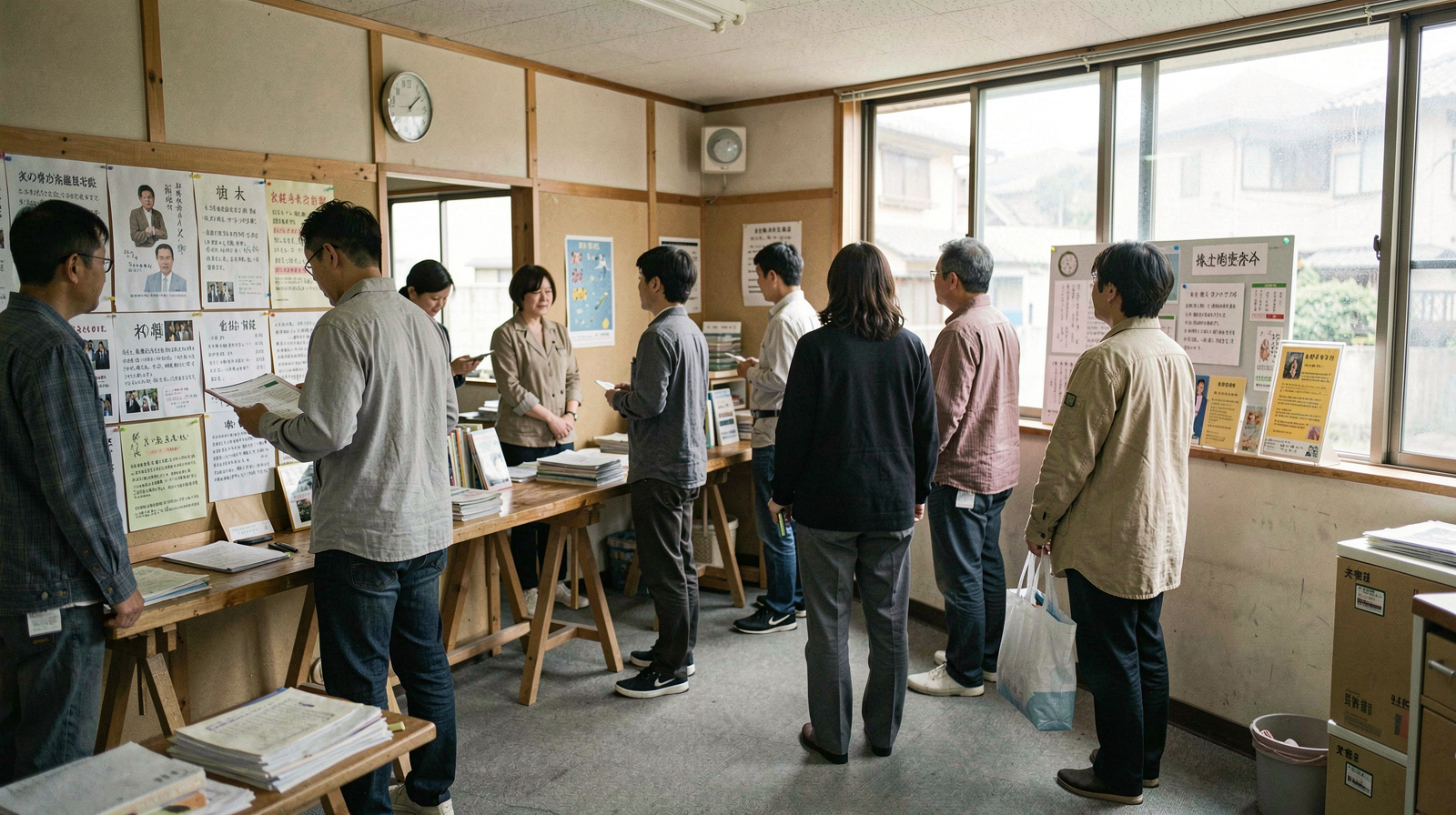
The countdown drawer is the image that opens the magazine: a notice covered wall and a row of trestle tables used as a counter, with about a dozen people standing and waiting. It is a generic Japanese neighbourhood setting, and it captures the ordinary administrative texture of leaving. The flight date is fixed. Everything else is placed around it.